Keeping up with the constant flow of scientific publications has become a serious challenge for researchers across all disciplines. Hundreds of new papers appear every day, making it increasingly difficult to identify what is truly relevant.
At AI-Sunrise, we addressed this problem by designing IArxiv.org, a platform that uses unsupervised machine learning to help scientists read smarter, not harder.
Learning Scientific Interests Automatically
IArxiv is built around the idea that a researcher’s interests can be inferred directly from their reading behavior — without manual configuration or explicit labeling.
To achieve this, the platform relies on Latent Dirichlet Allocation (LDA), a probabilistic topic modeling algorithm that:
- Identifies latent thematic structures in large text corpora
- Represents each paper as a mixture of topics
- Learns user preferences from interaction patterns over time
This fully unsupervised approach allows the system to adapt naturally as research interests evolve.
From Raw Papers to Personalized Rankings
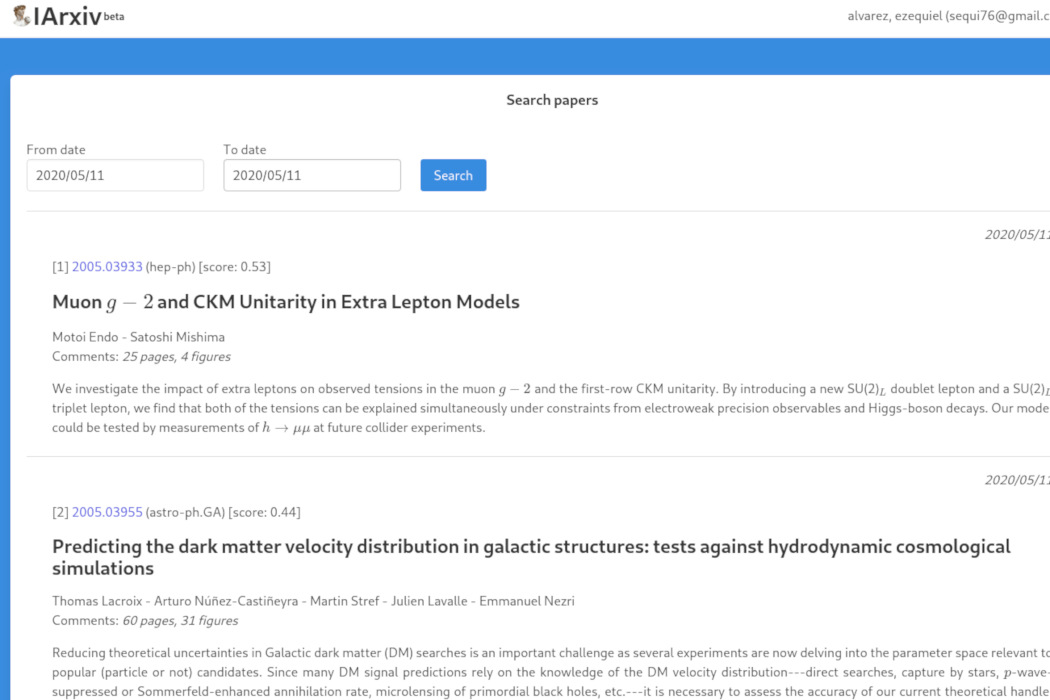
Every day, IArxiv processes the full batch of newly published scientific papers and automatically sorts them according to each user’s inferred topic profile.
This enables researchers to:
- Quickly surface the most relevant papers
- Discover connections across subfields
- Reduce time spent filtering irrelevant content
The goal is not to read more papers — but to read the right ones.
A Tool for the Global Scientific Community
IArxiv has been adopted by scientists worldwide as a daily companion in their research workflow. By transforming unstructured text into meaningful, personalized rankings, the platform acts as an intelligent assistant for scientific discovery.
AI in Service of Knowledge
This project exemplifies how unsupervised machine learning and natural language processing can augment human expertise rather than replace it.
At AI-Sunrise, we believe that AI should reduce cognitive overload, amplify insight, and support the pursuit of knowledge — one paper at a time.