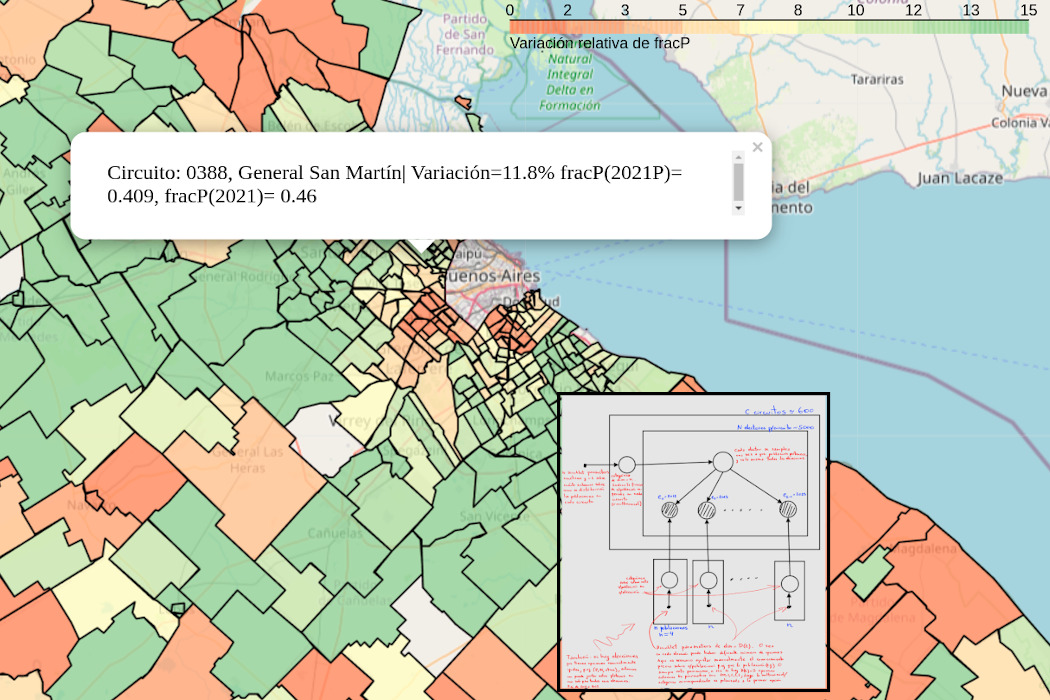
Understanding how populations are distributed and mixed across regions is a central challenge in modern electoral analysis. When only aggregate election results are available, extracting meaningful demographic and behavioral insight requires more than descriptive statistics — it demands rigorous modeling and inference.
At AI-Sunrise, we tackled this challenge by combining Bayesian inference, graphical models, and advanced statistical techniques to build what we call an Electoral Fertility Map.
From Aggregate Results to Latent Populations
Election data is typically published in aggregated form: total votes per region, per party, per election. While informative, this data hides the underlying population structure — who lives where, how groups overlap, and how voting behavior mixes spatially.
Our goal was to infer these latent populations using only public, aggregated election results. This posed both conceptual and technical challenges, requiring careful model design and validation.
After extensive exploration, we identified the appropriate graphical model to represent the generative process behind the observed data.
Bayesian Modeling and EM Inference
Once the structure was defined, we applied Bayesian inference techniques, using an Expectation–Maximization (EM) algorithm to estimate the latent variables of the system.
This approach allowed us to:
- Infer population mixtures at regional levels
- Quantify uncertainty in all estimates
- Ensure statistical consistency across elections and geographies
Crucially, every result was accompanied by well-defined uncertainty bounds, ensuring interpretability and robustness.
The Electoral Fertility Map
One of the most impactful outcomes of this work was the Electoral Fertility Map — a spatial representation highlighting regions with the highest potential for electoral impact.
Rather than relying on intuition or coarse indicators, the map provided a data-driven guide to:
- Identify electorally “fertile” regions
- Optimize resource allocation
- Focus campaign efforts with surgical precision
Central values are meaningless without uncertainty. This map tells not only where to act, but how confident we are in that decision.
Turning Insight into Strategy
By exploiting the inferred latent structure to its full extent, our client was able to align strategy directly with data-driven insight. Efforts were concentrated exactly where they mattered most — maximizing effectiveness while minimizing waste.
The result was not just better analytics, but measurable impact.
Science-Driven Decision Making
This project exemplifies how scientific thinking, when combined with modern AI and statistics, can transform public data into actionable intelligence.
At AI-Sunrise, we don’t just analyze data — we model reality, quantify uncertainty, and turn complexity into clarity.