Dengue outbreaks pose a major challenge for public health systems worldwide. The dynamics of transmission are complex, nonlinear, and often poorly observed, making early detection and prevention particularly difficult.
At AI-Sunrise, we applied Bayesian Machine Learning to model, understand, and anticipate dengue epidemics before they fully emerge.
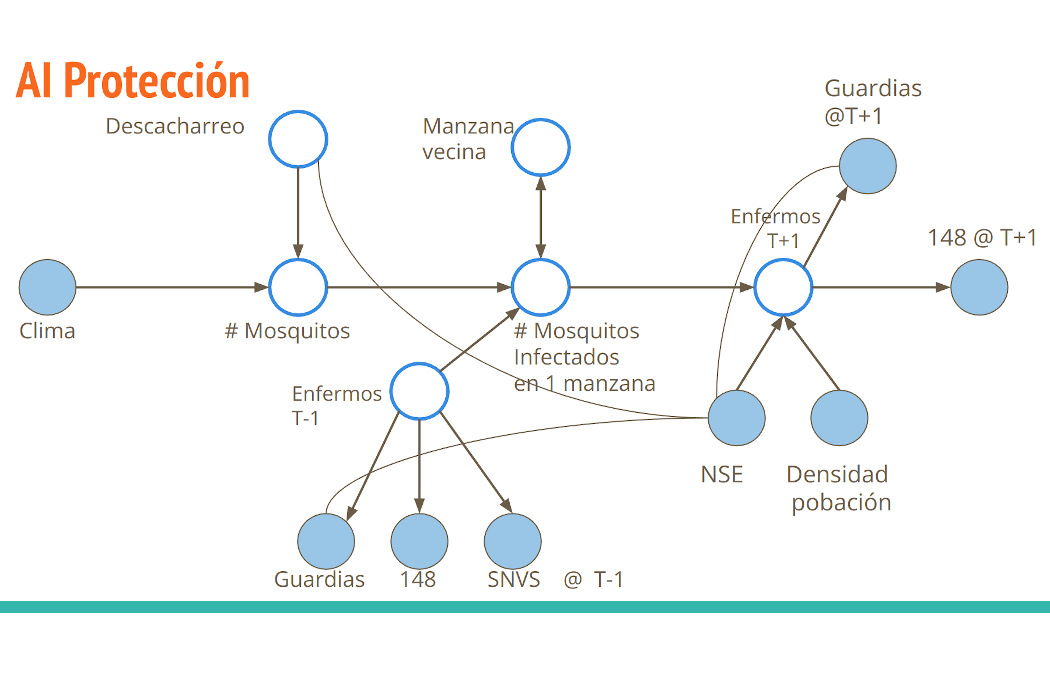
A Complex Transmission Problem
Dengue transmission is intrinsically a two-step process: the epidemic requires two mosquito bites at different times to propagate. This makes the system a complex interaction of observable and unobservable factors.
In our modeling framework:
- Observed variables (represented as filled nodes) include reported cases and environmental indicators
- Latent variables (empty nodes) capture hidden dynamics, such as infected mosquito populations
Capturing both aspects is essential to understanding how outbreaks arise.
Bayesian Learning with Prior Knowledge
Bayesian Machine Learning provides a natural framework for this problem. By incorporating prior information for each variable, the model can:
- Learn relationships between observed and latent variables
- Quantify uncertainty at every stage of inference
- Update predictions as new data becomes available
Rather than producing single-point estimates, the system yields full probability distributions, reflecting the true uncertainty of the process.
Mapping Risk at High Spatial Resolution
One of the key outputs of the model is a probabilistic estimate of infected mosquito populations at the level of H3 hexagonal blocks. This spatial resolution allows for:
- Early identification of high-risk areas
- Targeted intervention strategies
- Efficient allocation of public health resources
Early insight is the difference between reacting to an outbreak
and preventing it altogether.
From Prediction to Prevention
By providing early, uncertainty-aware estimates of outbreak risk, this approach enables governments and public health agencies to deploy preventive policies before case numbers escalate.
This project demonstrates how Bayesian inference and scientific modeling can turn complex epidemiological data into actionable intelligence — helping protect communities through informed, timely decisions.